
gznl.ai — vol.06 · the comment-wow drop
THE FIBER CODEX eight pixel-stretch AI prompts — and the free Claude skill that writes yours.
( eight ordinary photos. eight different fiber systems — unravelled, ascending, spiralling, layered, tunnelled, escaping, mirrored, cornered. zero photoshop. you commented WOW — so here is every prompt, in full. )
anyone can smear a photo into streaks.
a stretch only becomes art when the streaks have a reason.
threads must start somewhere real — a gesture, a light source, the weave of a face — and travel somewhere true.
eight artworks. eight different reasons. every exact prompt is printed under the piece it made — copy it in one click.
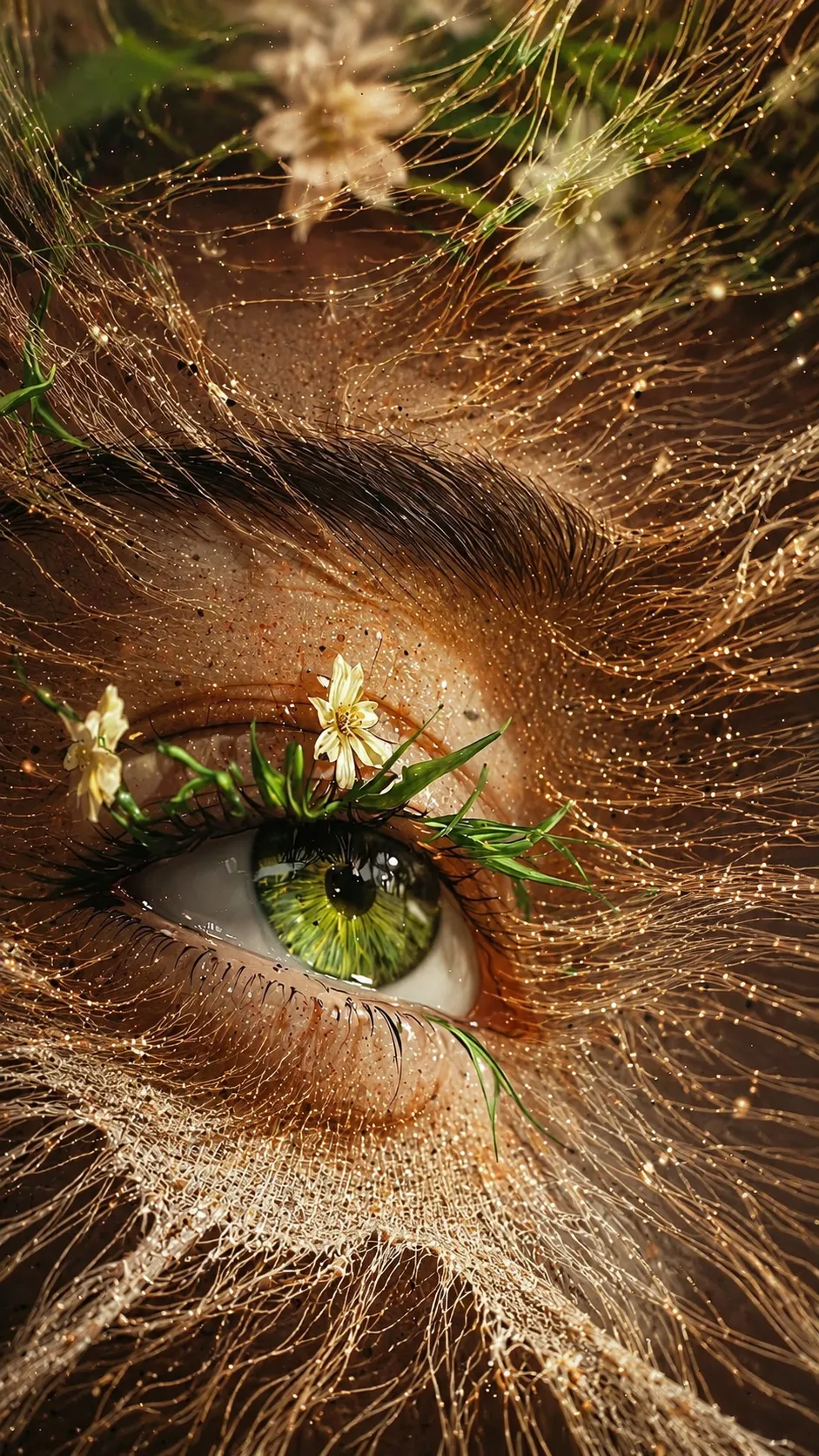
№ 01 · the weave comes undone
the unravel
the portrait is a tapestry and it is coming apart — skin separates into embroidery threads from the edges inward. the eye is the one region the unravelling cannot touch.
the receipt
the exact prompt behind the unravel
why it works: the stretch is given a metaphor, not a direction — cloth, not blur. That single idea buys the glitter-as-beads detail, the "last stitches" still anchoring the eye, and the depth behind the loosened weave. Restraint does the rest: the iris is protected absolutely.
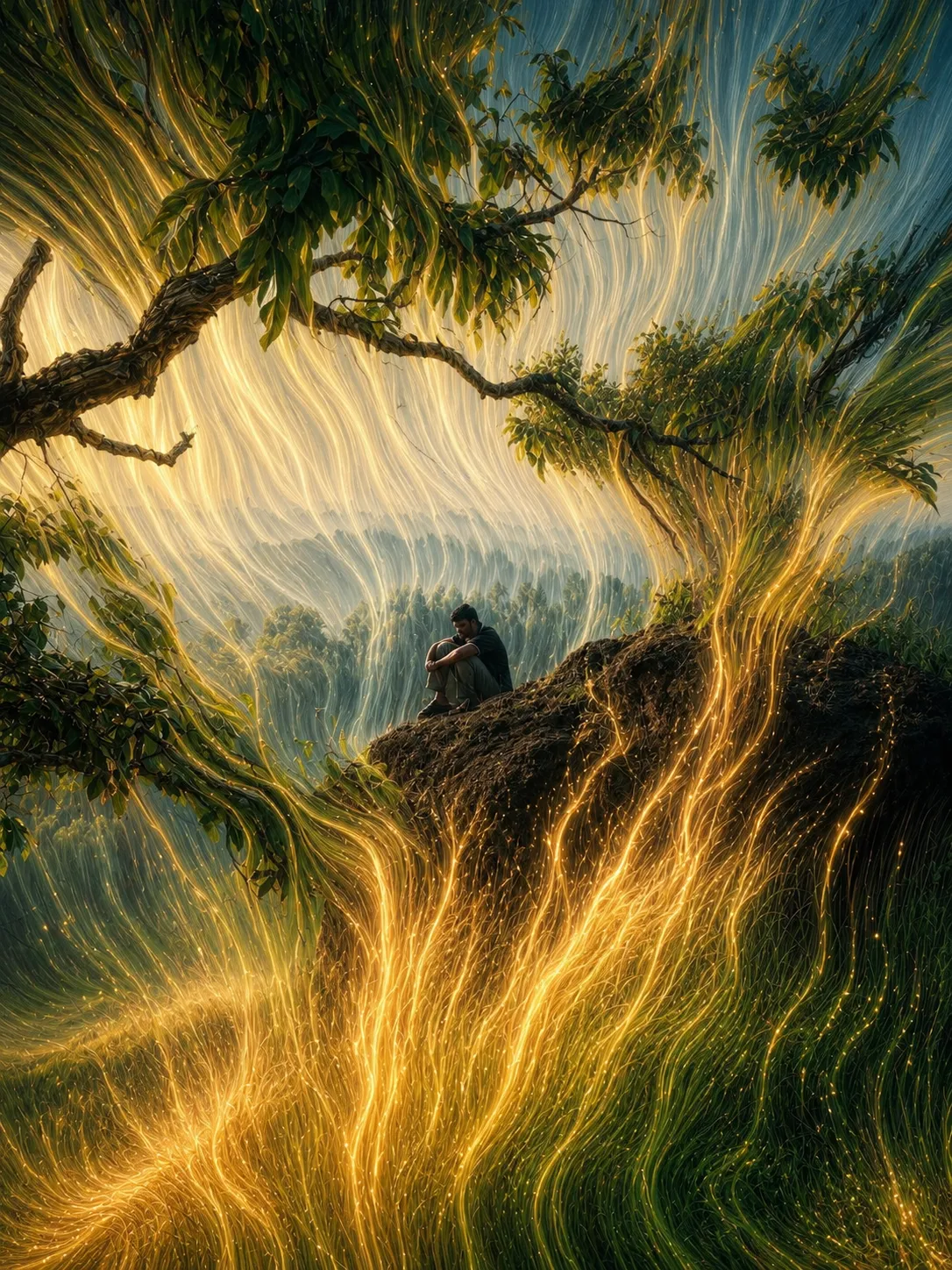
№ 02 · the world grows upward
the ascent
golden grass climbs into the air like luminous roots reaching for the sky. he is the only weight in a rising world.
the receipt
the exact prompt behind the ascent
why it works: one direction, obeyed by every zone — grass, mist, hills, sky all rise. Because everything moves and he does not, the stillness becomes the subject. The tree keeps solid bark and feathers only at the leaf tips: never a hard cutout.
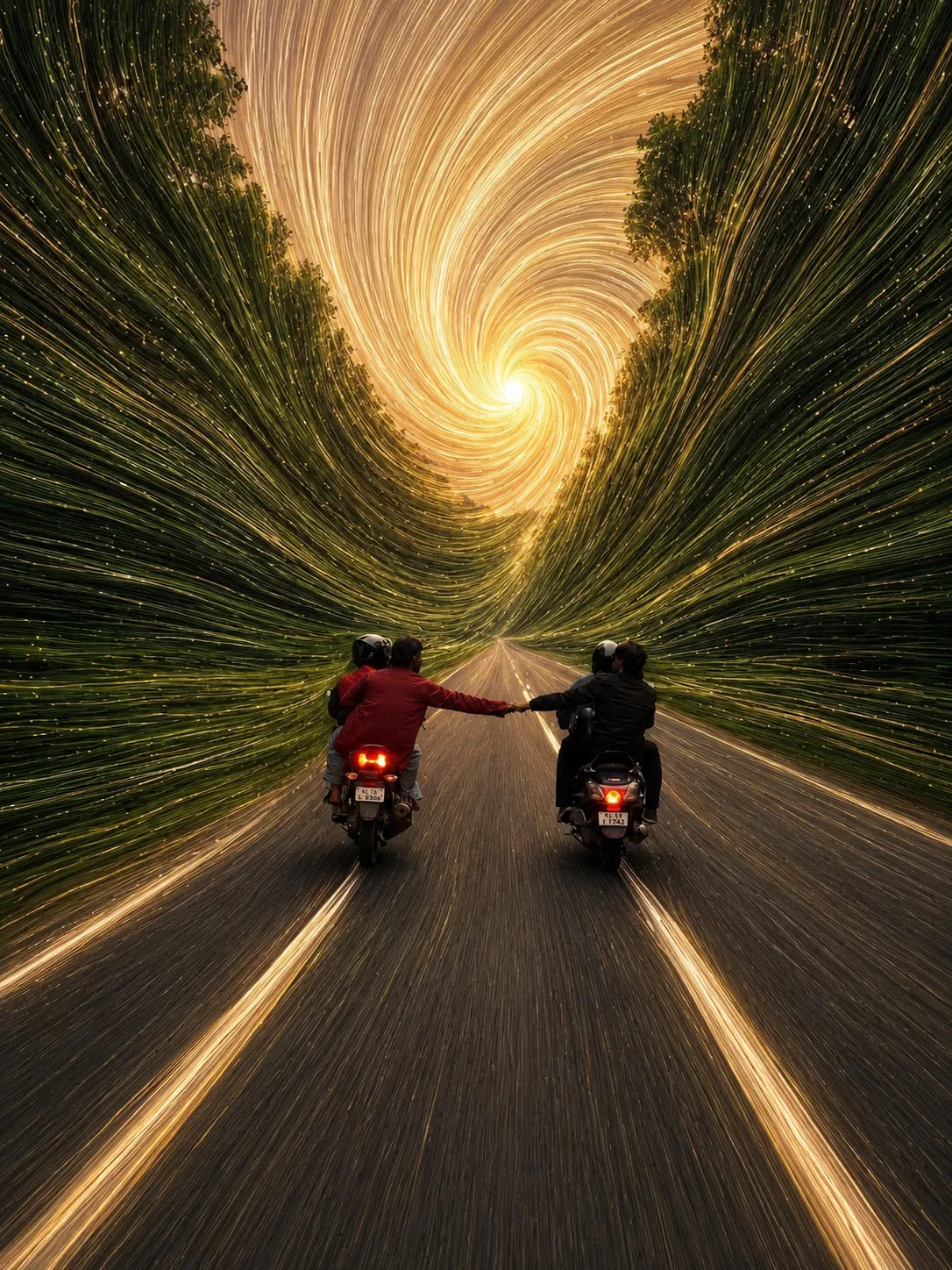
№ 03 · the sun as axis
the spiral
the tunnel of trees is drawn into the turning sun. the clasped hands hang sharp in the calm heart of it.
the receipt
the exact prompt behind the spiral
why it works: naming an axis — the sun — gives every other zone somewhere to go. Walls stream backward, lane lines sweep forward, and both curve up to join the rotation, so the frame has one engine instead of three competing effects.
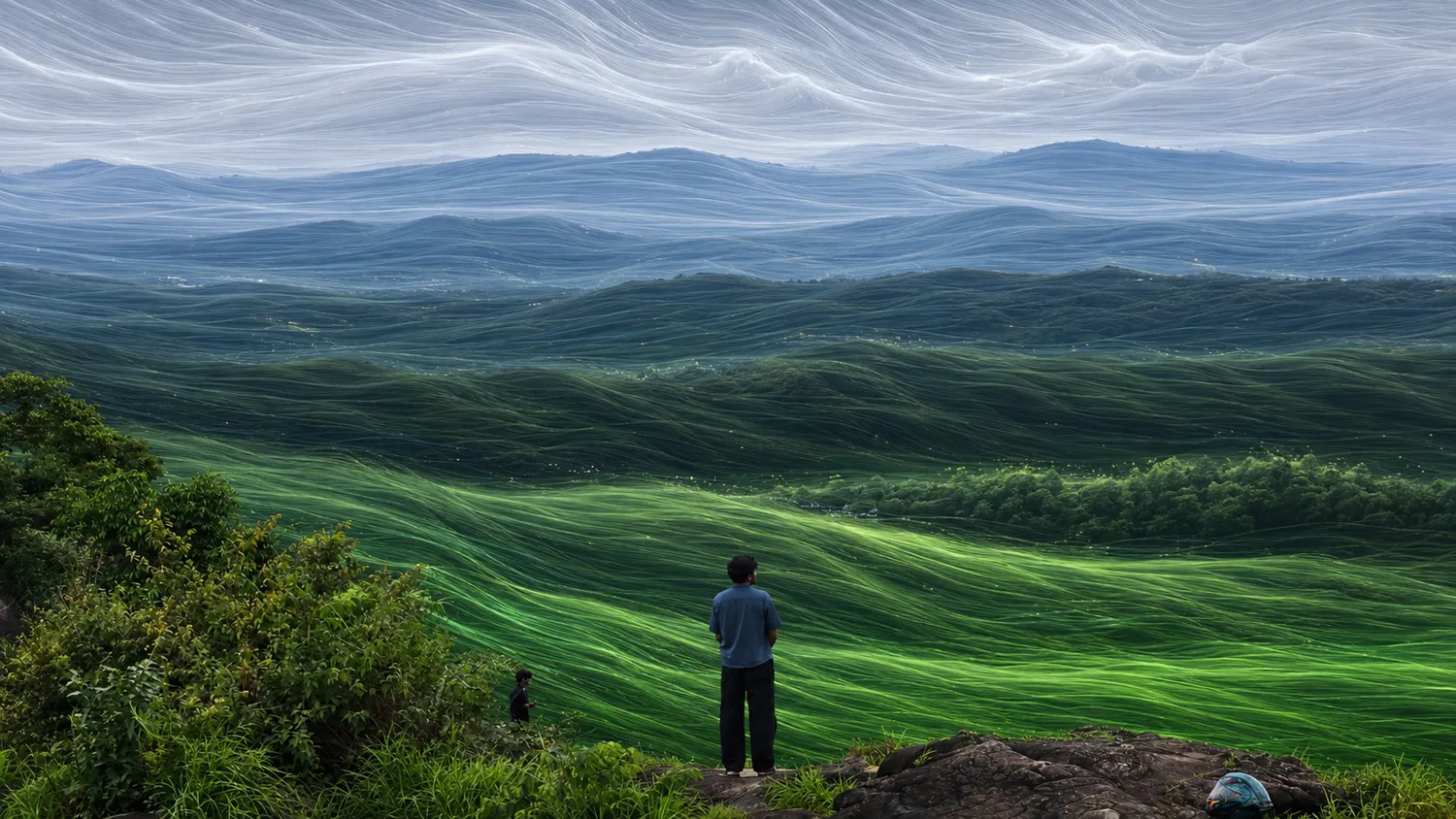
№ 04 · five rivers of time
the strata
five layered rivers, each flowing at its own speed. time itself moves faster the closer it is to him.
the receipt
the exact prompt behind the strata
why it works: depth is converted into speed. By assigning each distance band its own velocity — fast bold emerald near, whisper-thin veils far — the prompt turns a flat landscape into parallax you can feel in a still image.
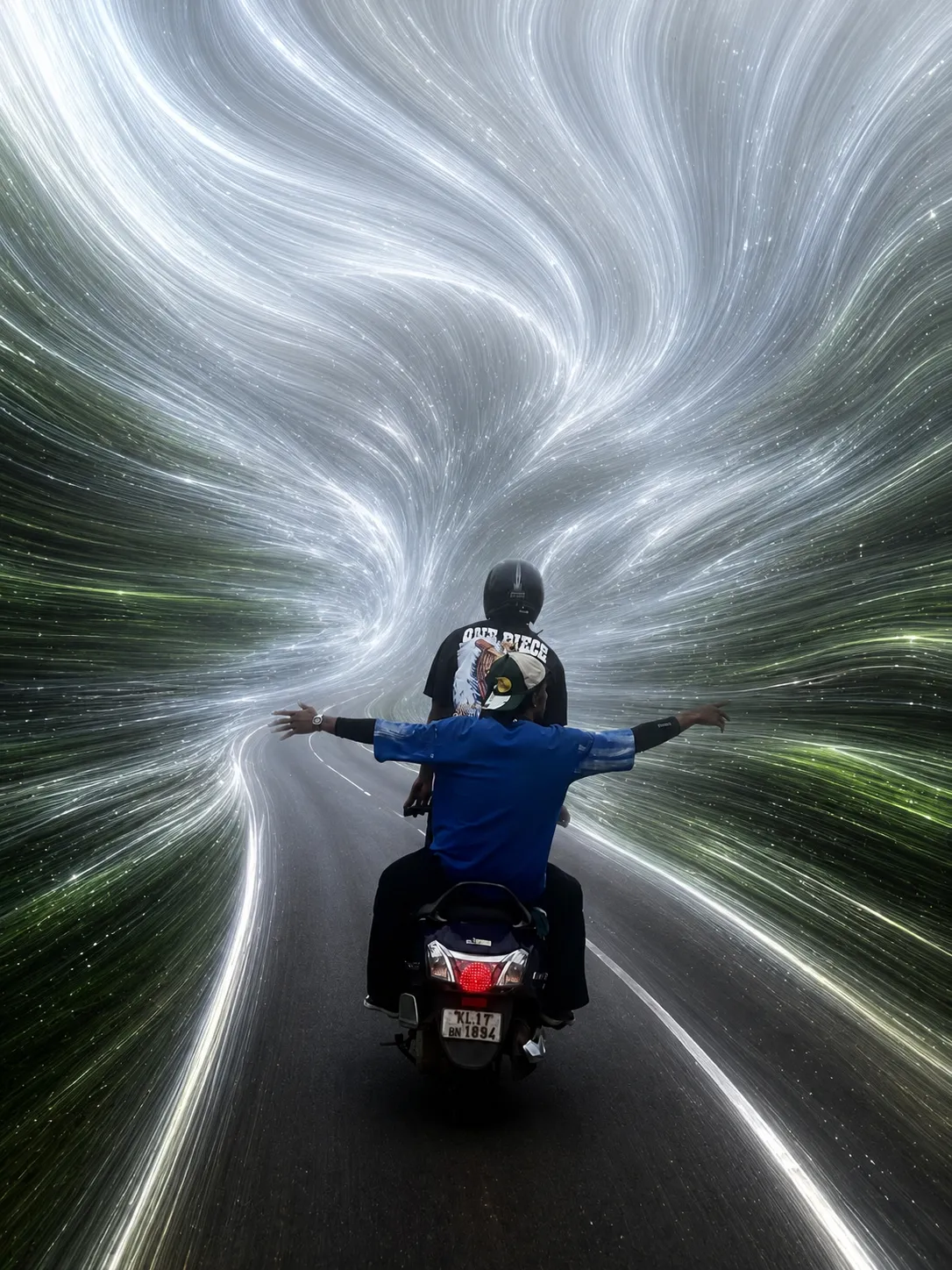
№ 05 · the corridor in motion
the tunnel
the misty corridor liquefies and rushes past them. one red taillight — the only warm ember in a cool world.
the receipt
the exact prompt behind the tunnel
why it works: the flat grey fog was the problem, so the concept makes the fog the material — lifted into luminous pearl-silver, it becomes the ceiling of the tunnel. One ember of red is rationed against it, and the whole frame gains a temperature.
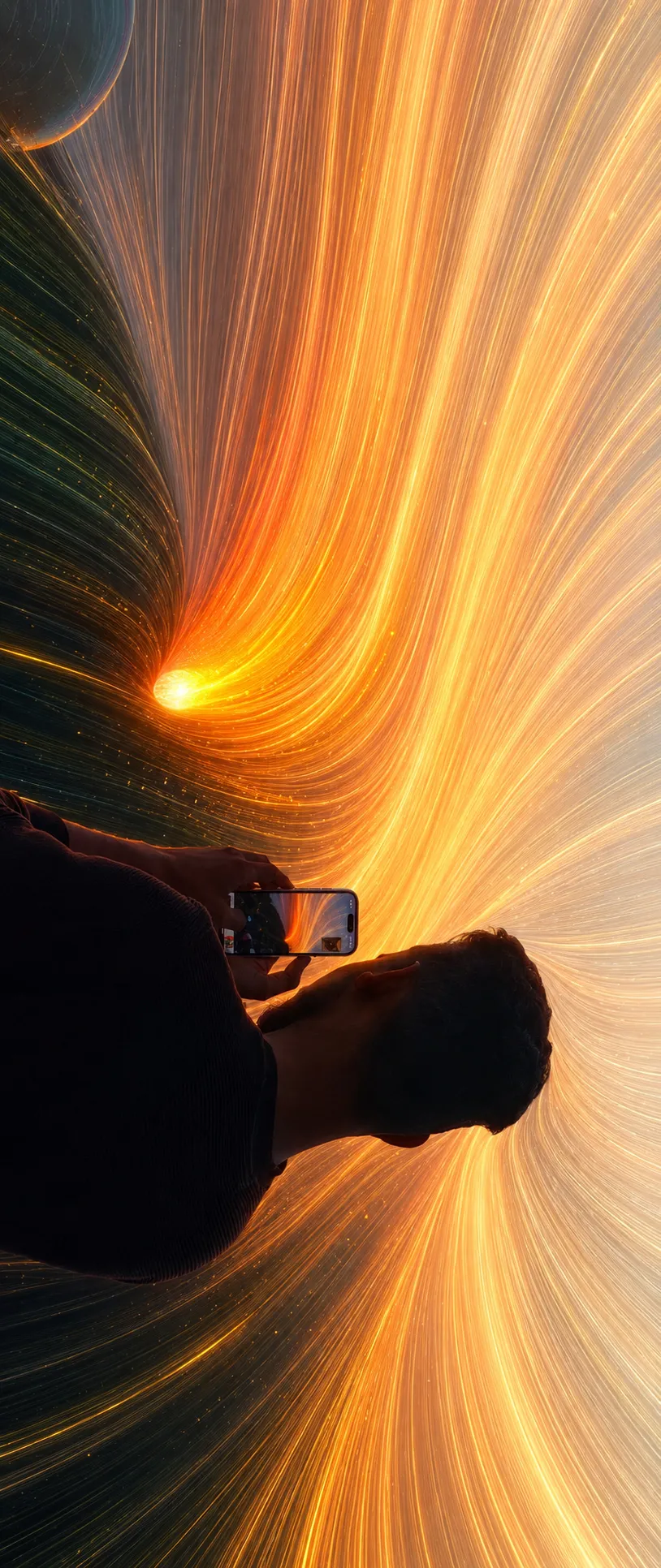
№ 06 · only the photo holds still
the escape
the moment he captured it, the real sky refused to stay. the photograph holds what the world would not.
the receipt
the exact prompt behind the escape
why it works: the best one in the set, because the protected zone carries the meaning. Keeping only the phone screen crisp turns a technical rule into the whole idea: the world escapes, the picture keeps it. Every fiber runs one diagonal — no competing directions.

№ 07 · canopy against river
the currents
canopy sweeps one way, the river answers the other. two halves of one breathing system — and they walk between them.
the receipt
the exact prompt behind the currents
why it works: opposition. Two currents running against each other create tension a single sweep can't — and the sharp trunks standing between them are what make both readable. The friends stay small, calm and untouched at the centre of the argument.

№ 08 · emerged from the flow
the corridor
the forest rushes toward a vanishing point and the car has just emerged from it — sharp, still, and unbothered.
the receipt
the exact prompt behind the corridor
why it works: the wet asphalt continues the flow as stretched reflections — that single line is what welds the car to its world instead of pasting it on top. Deep clean blacks hold the crimson paint up; the fog does the glowing so the car doesn't have to.
the machine behind the receipts
the skill that chooses your stretch for you
every prompt above was written for one specific photo — its pose, its light, its palette, its problem. yours needs its own. pixel-stretch-prompter is the free skill that does the choosing: it reads your image first, finds the one concept that actually has an origin in the frame, and writes the premium prompt — never the generic swirl-everything filter look.
step 01
install it
download the skill below and add it to Claude (claude.ai → Settings → Capabilities → Skills → upload). using ChatGPT instead? copy the skill as text and paste it into your chat first.
step 02
send your photo
say “stretch this.” the skill reads the pose, the anchors, the flow lines and the true palette — then writes ONE authored prompt built for that exact frame.
step 03
render it
paste the prompt + your photo into any AI image editor (ChatGPT, Gemini / Nano Banana…). one render. zero photoshop. gallery wall.
( free. no email. you commented WOW — that was the price. )
read the skill's full method — the whole thing, nothing held back
# Pixel Stretch Prompter
Turn any uploaded image into ONE premium pixel-stretch prompt that feels authored, cinematic, and different from the saturated trend — never a generic "swirl everything" filter prompt.
## Step 1 — Analyze the image FIRST (never skip)
1. Subject & pose: what are they DOING? A gesture (open arms, trailing hand, mid-stride, reaching) becomes the source of the stretch. A static pose needs a different origin (reflection, background depth, mist).
2. Anchors that must stay sharp: subject, whatever they stand/sit on, their ground shadow, the immediate foreground — a "protected zone." The protected zone can carry the meaning (keep only the phone screen crisp and the whole world escaping around it becomes the idea).
3. Natural flow already in the frame: vertical trees → vertical stretch; still water → reflection; mist → rising / light-shaft; motion in pose → directional wake; a road → tunnel/corridor; a sun → an axis to rotate around; backlit feathery subjects → the subject dissolves into light.
4. The real palette: list ONLY colors that exist in the photo. NEVER introduce colors that aren't present.
5. The grade problem: flat grey/overcast frames need the grade fixed INSIDE the concept (fog becomes the luminous material of the tunnel).
## Step 2 — Pick ONE concept that fits THIS image
- Motion source: stretch radiates from a gesture.
- Depth split (Living Backdrop): foreground real, everything behind melts into a flowing painted canvas.
- Subject dissolve (The Offering): backlit feathery subjects unravel into strands of light.
- The weave (tapestry): the surface is cloth coming undone; skin/texture separates into embroidery threads. Protect the one region the unravelling cannot touch.
- The axis: a sun or light becomes the center every other zone rotates into.
- Strata: convert depth into SPEED — each distance band flows at its own velocity.
- The tunnel: a road/corridor liquefies and rushes past a still subject.
- Mirrored currents: two zones flow in OPPOSITE directions with something sharp standing between them.
- Mist-into-light: turn dead grey mist into luminous shafts — fixes grade and adds effect in one move.
Concepts must (a) have a believable origin in the photo, (b) be ONE idea.
## Step 3 — Color rules (this is where wow lives)
- Color stretches too, not just shape. Where two ribbons cross they blend into NEW in-between tones.
- Each fiber carries the true color of the pixel it grows from — always include this; it prevents recoloring.
- Strict palette honesty: end every prompt with "no colors that are not already present in the original scene."
- Fiber texture: describe ribbons as "countless combed hairline strands with softly glowing cores" — this is what separates premium from smeared.
- Ration one warm ember against a cool world (a taillight, a sun) — contrast of temperature beats saturation.
- Glow rationed: glowing cores and faint spark particles only. Never scene-wide glow.
## Step 4 — Write the prompt
ONE cohesive lowercase paragraph starting "transform the uploaded image into a premium pixel-stretch digital artwork." Order: protection clause → the one concept → color/fiber behavior → grade line → seamlessness + physics → finish + negatives ("no glitches, no broken pixels, no hard cutout edges, no plastic smoothing, no cartoon rendering, no colors that are not already present in the original scene").
## Step 5 — Deliver
Give ONE prompt. Lead with why this concept fits their photo (reference the actual pose/light/palette). End with exactly ONE "dial" — a single swap to push intensity up or down.
## Hard NEVERs
- NEVER stack multiple effect systems at once.
- NEVER bury the subject — keep it fully visible with breathing room.
- NEVER fully freeze a large foreground element into a hard cutout — feather its edges while the core stays solid.
- NEVER over-describe the subject — say "same, untouched" and move on.
- NEVER invent colors or use "8k / HDR / masterpiece" hype words.
- NEVER give a motion effect to a clearly static pose.
before you ask
questions, answered
what is the pixel-stretch effect?
pixel stretch is a photo-manipulation style where pixels are pulled into long silky fibers of color — classically done in photoshop by dragging a single row of pixels. this version skips the software entirely: one written prompt + your original photo in an AI image editor produces the finished artwork. all eight pieces here were made that way.
do i need photoshop or any editing app?
no. zero photoshop, zero lightroom, zero layers, zero masks. copy a prompt from this page, attach your photo in an AI image editor, and render.
which AI tools do these prompts work in?
any image model that accepts a photo plus text instructions — ChatGPT (GPT Image), Google Gemini / Nano Banana and similar. the skill runs in Claude (or pasted as text into ChatGPT) and its job is to write the prompt for your specific photo.
how do i install the pixel-stretch-prompter skill?
download the .zip above. on claude.ai: Settings → Capabilities → Skills → upload the zip. in Claude Code: unzip into your .claude/skills folder. on ChatGPT: use “copy skill as text” and paste it at the start of your chat, then send your photo.
why do generic pixel-stretch prompts look cheap?
because they smear the whole frame with no origin, bury the subject, and invent neon colors that were never in the photo. every prompt on this page does the opposite: protect the subject absolutely, pick ONE concept that has a believable origin in the frame, and never introduce a color that isn't already there. that restraint is the entire difference between a filter and an artwork.
can i use these eight prompts on my own photos?
yes — each works best on a photo with a similar structure (a face, a road, a valley, a sunset, a figure under trees). but your photo deserves its own concept — that's exactly what the free skill is for: send it your photo and it writes yours.